Cell Division — Mitosis Explained Simply (Class 11 / NEET)
What is Mitosis?
Mitosis is a type of cell division where one cell divides to produce two identical daughter cells.
Both daughter cells have the same number of chromosomes as the parent cell.
Why does it matter?
- Growth of the organism
- Repair of damaged tissues
- Replacement of old cells
🔑 Key Point
Mitosis is called equational division because the chromosome number remains the same in daughter cells. Parent: 46 chromosomes → Daughter 1: 46, Daughter 2: 46.
The Cell Cycle — Before Mitosis Begins
Mitosis is just one part of the cell cycle:
- G1 Phase — Cell grows, makes proteins, RNA
- S Phase — DNA replication happens (2N → 4N DNA content)
- G2 Phase — Cell prepares for division, checks for errors
- M Phase — Actual mitosis + cytokinesis
🧠 Remember
S phase is when DNA doubles. After S phase, the cell has the same number of chromosomes (46) but each chromosome now has two chromatids joined at the centromere.
Phases of Mitosis
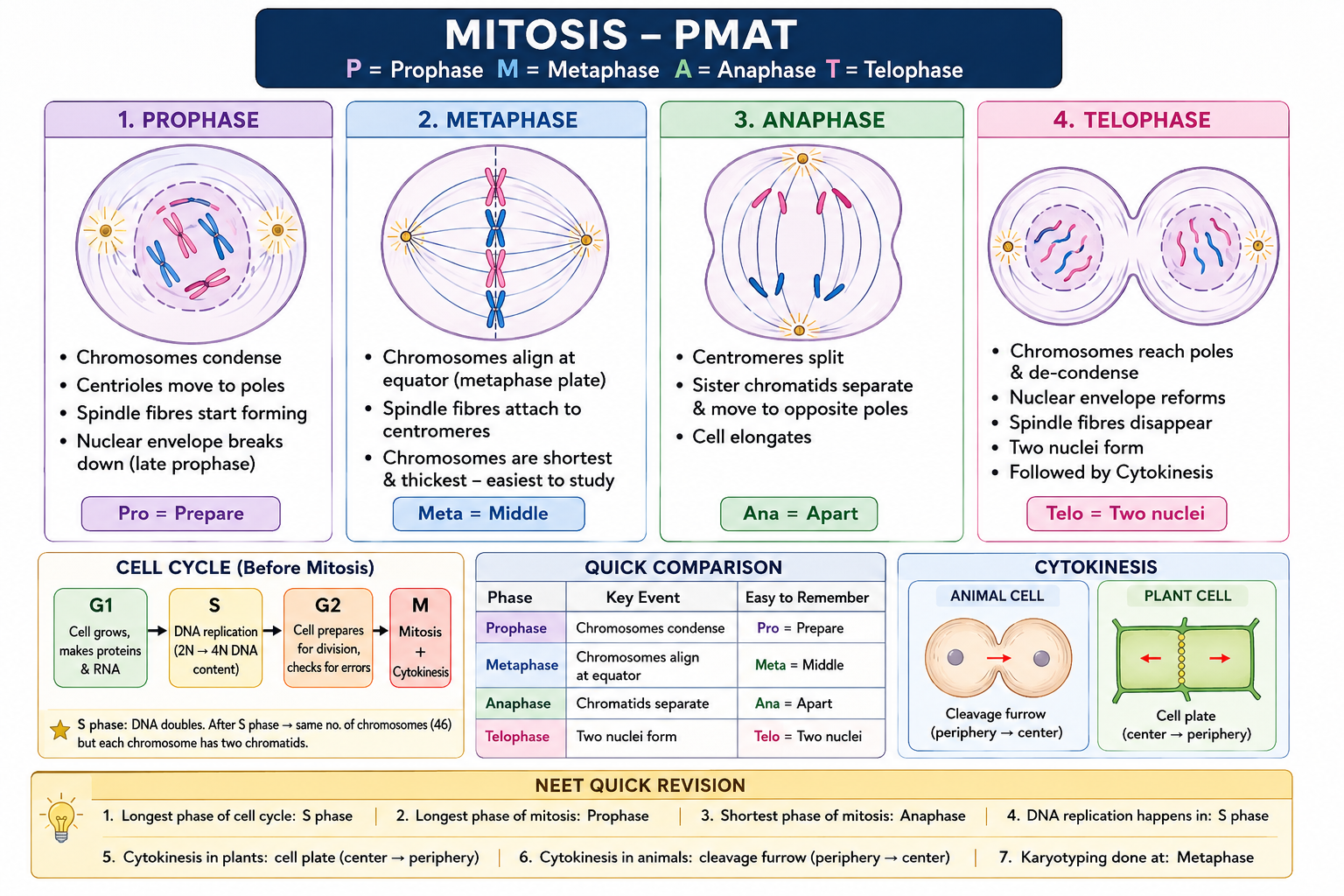
Mitosis has 4 phases: PMAT — Prophase, Metaphase, Anaphase, Telophase
1. Prophase
What happens:
- Chromatin condenses → chromosomes become visible
- Centrioles move to opposite poles
- Spindle fibres start forming
- Nuclear envelope breaks down (at the end of prophase)
Key point: Chromosomes are most visible in late prophase.
🎯 NEET Tip
NEET often asks: "In which phase are chromosomes most clearly visible?" Answer: Metaphase (they are at the equatorial plate). Don't confuse with "first visible" which is prophase.
2. Metaphase
What happens:
- Chromosomes align at the cell equator (metaphase plate)
- Spindle fibres attach to centromeres (kinetochores)
- Each chromosome is pulled equally from both sides
Why it matters:
This is the stage where chromosomes are shortest and thickest — easiest to count and study.
Karyotyping (chromosome mapping) is done at metaphase.
3. Anaphase
What happens:
- Centromeres split
- Sister chromatids separate and move to opposite poles
- Cell elongates
Key distinction:
In mitosis anaphase: chromatids separate
In meiosis anaphase I: homologous chromosomes separate (chromatids stay together)
🧠 Remember
At anaphase of mitosis, the number of chromosomes doubles temporarily — because chromatids become individual chromosomes as they separate. In a human cell: 46 → 92 chromosomes moving (46 to each pole).
4. Telophase
What happens:
- Chromosomes reach the poles and de-condense
- Nuclear envelope reforms around each set
- Spindle fibres disappear
- Two nuclei form
This is followed by Cytokinesis — actual division of cytoplasm:
- In animal cells: cleavage furrow forms (cell membrane pinches inward)
- In plant cells: cell plate forms (from Golgi vesicles, middle to edges)
🎯 NEET Tip
Cell plate formation goes center to periphery in plant cells. Cleavage furrow goes periphery to center in animal cells. NEET loves this distinction.
Quick Comparison Table
Mitosis Phases — Quick Comparison
| Phase | Key Event | Easy to Remember |
|---|---|---|
| Prophase | Chromosomes condense | Pro = Prepare |
| Metaphase | Chromosomes align at equator | Meta = Middle |
| Anaphase | Chromatids separate | Ana = Apart |
| Telophase | Two nuclei form | Telo = Two nuclei |
Significance of Mitosis
- Produces genetically identical cells
- Essential for asexual reproduction in organisms
- Maintains chromosome number across generations of cells
- Involved in wound healing and tissue repair
🔑 Key Point
Mitosis is also called somatic cell division — it happens in all body cells except germ cells (which undergo meiosis).
NEET Quick Revision Points
- Longest phase of cell cycle: S phase (or Interphase overall)
- Longest phase of mitosis: Prophase
- Shortest phase of mitosis: Anaphase
- DNA replication happens in: S phase (NOT during mitosis)
- Cytokinesis in plants: cell plate (center → periphery)
- Cytokinesis in animals: cleavage furrow (periphery → center)
- Karyotyping done at: Metaphase
Tags